
Right on the heels of the successful Cheaper Home Batteries Program, the Australian Government introduced its Solar Sharer Offer (SSO) last month. From 1st July 2026, eligible households with smart meters may opt in to receive up to 3 hours of free electricity in the middle of every day.
The SSO has been introduced as part of reforms to the Default Market Offer (DMO), which applies to households and small businesses in South Australia, New South Wales, and South East Queensland. The reforms aim to strengthen consumer protections and provide an exciting opportunity for homes to save money on electricity during off-peak hours.
With the SSO rolling out in select states with hopes of further expansion, the question arises: If electricity is now free during the day, how can households adapt their energy consumption habits to make the most of it? If you’re wondering whether or not you may be eligible for the SSO, what solar panels and other installations add to the equation, or how you could make the most of this offer, then Solargain has got you covered!
In this guide, we’ll provide all you need to know about the Solar Sharer Offer, along with the latest expert advice from our team, so you won’t have to go in blind about this exciting new solar energy offer.
What is the Solar Sharer Offer?
The Solar Sharer Offer (SSO) is a regulated energy offer that provides eligible households with up to three hours of free electricity in the middle of the day. The program is designed to give more households access to solar energy when it is most abundant, rather than letting it go to waste. As part of reforms to the Default Market Offer (DMO), its aim is to strengthen consumer protections for households on standing offers who are unable to shop around for better electricity deals.
This initiative leverages abundant solar energy and encourages adopters to use power during peak availability. The 3-hour free window applies to primary load electricity usage, or the normal, continuous electricity usage drawn for appliances such as your fridge, microwave, or lights. Daily supply charge and controlled load charges will still apply during the free usage period, however.
Who is Eligible for the Solar Sharer Offer?
Because the Solar Sharer Offer is part of reforms to the DMO, it is currently only available to eligible households in New South Wales, South Australia, and South East Queensland. Households can choose to opt in to the SSO after considering its benefits.
The SSO is available to households that:
- Live in NSW, SA, or South East QLD.
- Have a household smart meter installed.
- Are renters or homeowners.
- Are not supplied through an embedded network.
- Are with a retailer that is required to offer the Solar Sharer Offer.
* If you do not have a smart meter, ask your retailer if one can be installed and whether any fees apply.
Victorian Midday Power Saver
Homeowners in Victoria are not eligible for the SSO, but they will have access to a similar program in their own state. The Victorian Government has announced the optional Victorian Midday Power Saver, which will give consumers a similar 3 hours of free electricity in the middle of the day.
The Midday Power Saver will be available to households and retailers from 1st October 2026, offering a free power window between 11 AM and 2 PM every day.
Who Will Benefit Most from the Solar Sharer Offer?
Three free hours of electricity a day are quite the prospect, but who will actually benefit most from the Solar Sharer Offer varies from household to household. Households that already have rooftop solar may see some of the strongest value from SSO, particularly if they are planning to buy a battery or increase their storage capacity. Households with a battery installed, renters, or anyone who is home during the free energy window at midday will also benefit.
A larger battery can store more low-cost or free midday electricity, helping households shift more usage away from expensive evening periods. This is even better for those who also own an electric vehicle, since they can capitalise on the free window to charge while home.
Those who may see the least immediate benefits are those who have solar installed but aren’t home during the day.
Does Solar Sharer Reduce the Need for Rooftop Solar & Batteries?
Because solar panels are not required to opt in for the Solar Sharer Offer, some electricity retailers are positioning the offer as a way to access cheaper daytime energy without needing to buy solar or batteries, but this is not necessarily true. While SSO might encourage households to take home energy technology more seriously, it doesn’t necessarily eliminate the need for rooftop solar or batteries.
The free midday window rewards households that can shift, store, or automate their energy use, and this is made much easier by solar installations, which increase the value of batteries, EV chargers, smart hot water systems, and home energy management software. Amber, an energy retailer, suggests it’s better to view the Solar Sharer Offer as an introductory tariff rather than a replacement for solar, batteries, and smart appliances.
“For households without solar, batteries, or EVs, the SSO seems particularly attractive as an option that can shift some demand into the free window,” she explained. “But electricity retailers with more advanced energy products position it as only one option, which is not the case.”
The key is therefore not simply whether a household qualifies for Solar Sharer, but whether it can actually make use of the free-energy window. For households seeking greater energy independence beyond the three-hour window, solar and smart appliances remain the best option.
“Batteries, EVs, and smart appliances can automatically respond to changing prices and may offer value outside the fixed 3-hour window,” Amber said. So while the SSO may provide an invaluable kickoff for households wishing to make use of the grid, it will be, for some, just the first step in optimising their homes for Australia’s changing electricity market.
Why Australia’s Electricity Market is Changing
The Solar Sharer Offer is built on the back of an oversupply of solar energy from rooftop panels, but in reality, solar panels are only one part of Australia’s new electricity market. For decades now, due to Australia’s overreliance on coal and fossil fuels, energy bills have only skyrocketed, so an opt-in program offering three hours of free electricity almost sounds too good to be true – but it isn’t!
Innovations like the SSO were once unimaginable, but now, thanks to solar energy and greater adoption of renewables like solar panels and solar batteries, it’s becoming the new reality. Australia’s electricity market is changing quickly, all for a number of interconnected reasons… and perhaps all for the better.
Solar Oversupply
As more and more residential and commercial solar installations pop up around the country, there is now a greater oversupply of solar energy flooding the grid. Wholesale electricity prices often drop to zero or go negative when supply exceeds demand, and programs like the SSO help more customers with limited retail choices benefit from the abundance.
Free Midday Electricity
Plentiful daytime solar has created periods of very low or negative wholesale prices, completely changing traditional peak and off-peak periods and allowing newer options for the public, such as time-of-use tariffs, including the SSO. Traditionally, off-peak hours were at night because fewer people were as active then. But now, solar is generating far more energy at midday, when generation peaks.
Growth of Clean Energy
Australia’s onshore coal and gas power stations are nearing the end of their operational lives, requiring the National Electricity Market (NEM) to find newer, more sustainable ways to keep the lights on, such as renewables and the Solar Sharer Offer. Programs like the SSO also align with the Government’s overall commitment to the United Nations’ SDG 7, which aims to ensure access to reliable, sustainable, and modern energy for everyone by 2030.
As we move closer to the 2050 deadline for Australia’s net-zero carbon emissions target, cleaner energy initiatives are steadily taking over both statewide and nationally and becoming the new normal.
What Should Homeowners Consider Before Switching?
Homeowners should assess the entire plan, not just the free electricity window. Solar Sharer provides a limited daily free period, with eligibility requirements, usage caps, and tariff conditions. Electricity used outside the free period is still charged, and those rates may be higher than other available plans.
Before switching, households should consider the following:
- The free window times and the 24 kWh reasonable-use cap.
- Peak, shoulder, off-peak, and overnight rates outside the free period.
- Daily supply charges and any controlled-load charges.
- Whether battery charging is allowed under the tariff.
- Whether their household can realistically move enough usage into the free period to save overall.
Optimising Your Home for Solar Sharer and Beyond
It is important to note that customers won’t automatically receive 3 hours of free electricity through the SSO. Only eligible customers in select states and regions who opt in to the offer structure and who have a smart meter installed at the property will benefit. Similarly, even those households who do qualify may not necessarily reap the most savings if their energy consumption doesn’t fall within the free period.
This dynamic actually creates even greater demand for home electrification and for smart products that use timers.
How Should Households with Solar, Batteries, or EVs Manage Their Energy?
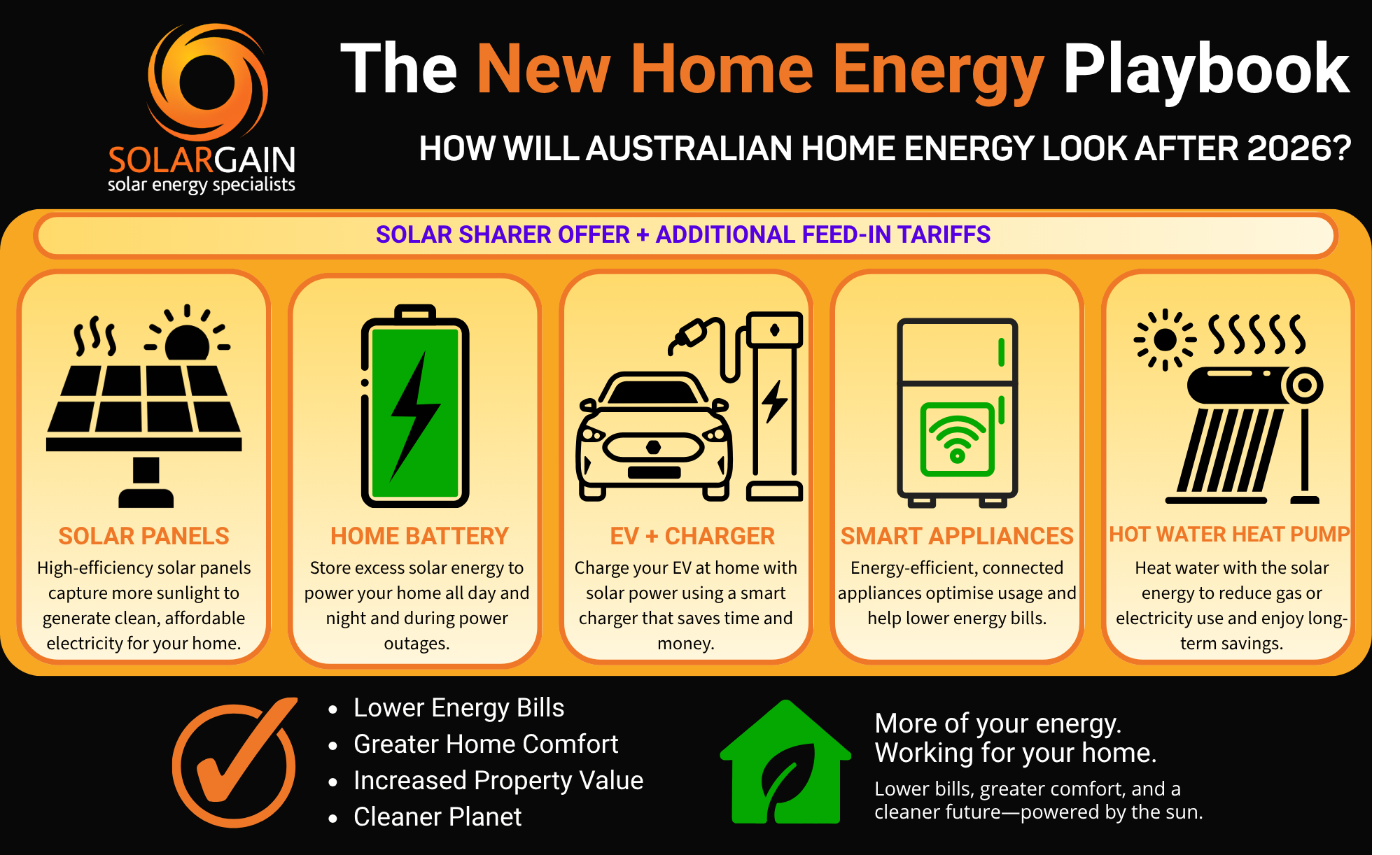
Increasingly, Australian homes are being optimised for lower energy bills, greater comfort, and higher property value, all while reducing environmental impact. The new Australian Home Energy Playbook will put much less emphasis on gas and fossil fuels and much more on renewables.
Through a combination of solar installations, hot water heat pumps, EVs, smart appliances, and available tariffs and programs like the SSO, homeowners will be better positioned to save money on running their homes while also future-proofing them.
The New Home Energy Playbook: Solargain Recommendations
For households that already have solar, battery storage, or an EV, the Solar Sharer Offer shifts the focus from simply generating energy to optimising when energy is consumed, stored, and exported. Depending on the layout of one’s home system and the combination of installations one has, different approaches will yield different results. Here are our recommendations for specific households
Solar + Battery
Traditionally, the goal has been to use rooftop solar to charge an inverter battery during the day and discharge it during the evening peak periods. But with Solar Sharer providing free grid electricity during the day, some households may benefit from retaining more of their own energy for export while charging their batteries from either solar or the free electricity window, depending on tariff settings and feed-in rates.
The optimal strategy will depend on the relative value of exports versus evening electricity costs.
Solargain Recommends:
- Charge battery during the free Solar Sharer window, if permitted and feasible.
- Reserve battery capacity for the evening peak period.
- Use smart battery controls to minimise grid imports during expensive periods.
Solar + EV
Electric vehicles are rapidly transforming the Australian energy market. With the increased installation of home EV chargers, optimising charging times has become crucial. EVs are among the most valuable assets for the transition to the free-energy period, offering significant savings for households, especially when vehicles are idle during the day.
For many, EV charging alone could capture a substantial portion of the Solar Sharer benefit.
Solargain Recommends:
- Schedule EV charging between 11 AM and 2 PM (or applicable free window).
- Prioritise free grid energy and excess solar generation during charging.
- Reduce charging during evening peak periods unless necessary.
Solar + Battery + EV
Integrating solar, battery storage, and electric vehicles provides the ultimate strategy for home energy optimisation. By aligning EV charging with the free-energy window and using solar power to maintain battery reserves, households can unlock substantial, long-term savings.
This is the optimal strategy for properties seeking to make the most of Australia’s changing energy market and represents the New Home Energy Playbook.
Solargain Recommends:
- Run major appliances during the free-energy period.
- Charge the EV during Solar Sharer hours.
- Charge the battery using excess solar generation and, where tariff rules allow, free midday electricity.
- Use the battery to power the home through the evening peak period.
Get Ready for the Future of Australian Home Energy with Solargain
The future of Australian home energy is likely to become increasingly electrified, connected, and responsive to energy prices. Rather than relying on a single solution, households will be able to combine multiple strategies, such as solar generation, battery storage, EV charging, smart appliances, hot water heat pump, and flexible rebates and tariffs, to manage their energy use according to their needs. The introduction of Solar Sharer indicates that Australia is shifting its thinking about energy on a national level, with more of it working in a consumer’s favour.
As the electricity market continues to change, households that can adapt will be better positioned to manage their energy costs and make the most of Australia’s growing supply of renewable electricity. Solar Sharer is changing the way Australians think about when and how they use electricity, but the best energy solution will look different for every household. Whether you’re considering rooftop solar, adding a home battery, charging an EV, or simply looking for smarter ways to use the energy you already have, our solar experts can help you understand your options.
The sun is setting a little more each day on expensive energy bills, but is your home ready for greater electrification? Get your home ready for Solar Sharer and beyond today with Solargain, and speak to a member of our team to future-proof your property.
Which Activities Should Move into the Solar Sharer Free Energy Window?
Households should prioritise flexible, energy-intensive activities that can be scheduled safely and conveniently, such as charging a battery or EV, running the dishwasher, washing machine or dryer, pre-cooling or heating the home, and heating hot water with a heat pump.
We’ve created a guide to show when it is cheapest to run common household appliances, so it’s easier to see how they stack up against a broader home electrification ecosystem.
