Earth Hour More Significant Than Ever

Submitted by Andrew on Tue, 29/03/2016 - 09:25
earth hour

This year Earth Hour was on Saturday March 19 and a record number of countries and territories switched off some of their brightest landmarks in support.

As grim reports continue to flood in surrounding the Earth’s rising temperature and the damage it’s causing, a show of support for climate action is not only important, but essential to our future. Just recently scientists claimed a ‘climate emergency’ off the back of record heat around the globe in February – indeed, the time for the world’s countries to make good on promises made at the Paris Conference is now.

But back to Earth Hour.

A WWF initiative, Earth Hour isn’t just for big cities. The event encourages all individuals, communities, households and businesses to turn off their non-essential lights between 8:30 and 9:30pm in their local time. The notion of switching off is symbolic of our united mission to preserve the planet and be more efficient with resources. You may be surprised to know that Earth Hour actually started right here in our own backyard in 2007 when Sydney famously turned off its lights.

In 2016 more than 178 countries and territories participated in the event with the lights of over 400 famous landmarks being switched off or dimmed for 60 minutes. Some of the more famous ones included the Sydney Harbour Bridge and Opera House, the city lights of Shanghai, the Eiffel Tower, London’s Big Ben and New York’s Time Square.

In a statement shortly after the event, Siddarth Das, the Executive Director of Earth Hour Global said ‘The past 24 hours have shown us yet again the impact we can achieve when we unite for a cause… Every light switch turned off represents a call to switch on our collective power and be the first line of defense for our planet as we form the frontlines of climate change.’

It’s a sentiment we couldn’t agree with more.

For tips about what you can do to help conserve the planet check out our blog Simple Things You Can Do To Help Save The Planet... and for more information about Earth Hour, head to the official website.


Solargain

Solargain Official Sponsors Of the Fremantle Football Club

Submitted by Andrew on Tue, 22/03/2016 - 10:15
Solargain - Official sponsors of the Fremantle Dockers

We’ve lined up the opportunity, kept our eye on the target, kicked… and scored official silver sponsorship status with the Fremantle Football Club.

The crowd goes wild!

We couldn’t be more excited to announce this brilliant news. Just like many of our customers around Australia, we’re big fans of the AFL and so the opportunity to support one of its leading teams is quite an honour.

But there’s something particularly special to us about the Fremantle Dockers.

The team from Perth’s south not only shares our birthplace city, but was officially admitted into the AFL competition in 1995 – the same year Solargain was born.

During the same 21 years, both the Fremantle Dockers and Solargain have risen from their underdog status to the top of the league, ever-ambitious to push for greatness.

As part of our sponsorship agreement, we’re going to do what we do best. We’ll be energising key Fremantle Dockers facilities with solar power, including:


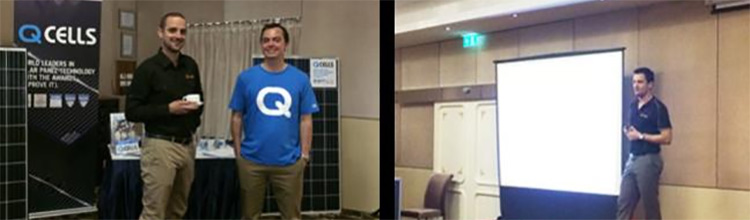
Like all our solar power installations, both will use industry-leading products. For the Fremantle Dockers project, we’ll source panels, inverters and railing from our key suppliers QCELLS,

Fronius and Clenergy.

In a recent media release Steve Rosich, Fremantle Dockers CEO, acknowledged the arrival of Solargain as a sponsor as well as three others.

He said, ‘We are delighted to welcome the support of four new sponsors, WFI, Beyond Bank, IGA and Solargain, all with whom we share strong values and a genuine commitment to positively impacting the community.’

We couldn’t agree more and we can’t wait to see what awesome things we’ll achieve with our new partners.


Solargain

Home Battery Storage – Your Questions Answered

Submitted by Andrew on Tue, 22/03/2016 - 10:06


Whatever name you use, the same meaning applies to these revolutionary batteries that are set to feature in millions of Australian homes over the next few years.


Put simply, solar batteries help you get the most out of your solar panels. They allow you to store electricity for later use during the evening or during blackouts and in some cases, provide the potential to go off-grid.

But we’re getting ahead of ourselves! Here’s a breakdown of all you need to know about home solar batteries:

What Are They?

The generation of home solar batteries we’re talking about use the latest lithium-ion technology. Sounds complicated, but you already use this kind of battery every day in your smart-phone, laptop, power tools or electric car – if you have one! These rechargeable batteries provide strong energy intensity, yet are lighter and lower maintenance compared to lead acid alternatives.

Haven’t Solar Batteries Been Around For A While

Home battery storage has never been so affordable and accessible. Up until now, solar batteries have been unobtainable for most homeowners – and with good reason. They’re heavy, expensive, and often require ongoing and costly maintenance.


Exciting new players to the home energy storage market, such as Tesla Energy, are changing the game. Tesla’s Powerwall is a light, efficient, ‘set and forget’ solution that will make homes more sustainable. Other companies with their eyes set to the Australian solar battery market include Enphase Energy and LG Chem.

How Do They Work?

Solar batteries are pretty uncomplicated and once installed you’ll likely forget they are there (except when your power bill arrives.)

The following is based an example that applies to most common battery systems:

  • Solar panels convert sunlight into electricity during the day, charging the batteries as well as providing power for the home.
  • Your inverter converts direct current electricity from solar panels and batteries into alternating current used by your home.
  • Electricity from the inverter is sent to your home's electrical panel.
  • Some backup installations may require a secondary electrical panel containing the critical appliances and outlets you wish to back up. An electrical switch automatically activates the backup panel during a power company outage (on applicable systems).

What’s The Benefit?

The new generation of home battery storage systems can offer an impressive range of benefits, including:

  • Dramatic increase in power bill savings
  • Significant reduction in emissions – which is better for the planet
  • Added property value
  • Potential to use power during a blackout (on selected installations)

Are they expensive?

The price of solar batteries has dropped dramatically compared to systems on offer just a few years ago. We currently stock a range of solar batteries with different capabilities and technology levels, so prices vary. To obtain a specific quote, have a chat with our team.

How long will they last?

This also depends on which solar battery system you choose to install. Even our entry-level batteries are well rated and are covered by a limited performance warranty of X years. More sophisticated batteries are expected to hold charge for even longer.

Will it be compatible with my current solar power system?

Almost all solar power systems currently installed are compatible with the new generation of batteries. Not all solar power systems will integrate with every battery, so the best way to find out which will work for you is to speak to a solar energy professional.

How Do I Find Out More?

It’s likely that you’ve still got some questions about solar battery systems. The best way to get them answered is to contact our team for an obligation-free chat. We’ll help you understand more about these exciting new products as well as which one will best suit your needs and budget.

So if you’re keen to know more, make sure you get in touch!

Solar Then Vs Now – How Much Can Change In 8 Years?

Submitted by Andrew on Mon, 07/03/2016 - 09:46
Solar Then Vs Now – How Much Can Change In 8 Years?

We don’t know about you, but 2008 doesn’t seem like that long ago to us.

Yet in the context of solar power, that short span of time from when solar panels first started making their way into Australia, to now, represents a huge shift in affordability and tech.

It’s hard to think that ten years ago there wasn’t really a solar PV panel in sight (especially when you look around Australia’s suburbs today).

Back in 2008 when they first started to become available to homeowners, you’d pay around $3,000 for a 1 kW system (1 kW inverter) – and that was after an $8,000 government rebate and another $1,000 worth of STCs (RECs back then). If you had an extra $500, you could get a bigger inverter (usually 2 kW) so that you could add more panels later – which was considered amazing back then!

If you wanted to add extra panels to your install, they’d cost about $1,500 each and they were only about 150 kW (compared to 250 kW+ today).

A 5 kW system in 2008 was extremely rare because it would cost… wait for it… around $40,000!

Aside from far better affordability, solar panels have come leaps and bounds in technology too.

Panels now perform better in lower light, are much more robust, less sensitive to heat and feature many other technical improvements.

Likewise for solar inverters. Today’s crop often come standard with dual tracking, wireless connectivity and online monitoring of production – all wild, futuristic concepts just eight years ago.

In 2016, you wouldn’t even consider installing a 1 kW system - it’s just too small.

The average size system our customers are choosing today is 3 kW, with many opting for the even bigger (and drastically more affordable) 5 kW option.

What’s next?

Solar power technology continues to change and evolve in really exciting ways. The next ‘revolution’ in solar tech is without a doubt, home battery storage. In 2024 (eek!) – which is only another eight years away, we predict that basically every home that has panels on its roof will have a battery collecting excess energy installed as well.

The best part about home battery storage is that the technology is already available now.

Here’s to the future!

Solargain

Sun Sets On WA Solar Tax

Submitted by Andrew on Mon, 22/02/2016 - 14:04
sun sets on wa solar tax


A collective sigh of relief has occurred for solar power owners in Western Australia with news of the controversial ‘solar tax’ being ruled out by WA’s Premier, Colin Barnett.

Here at Solargain, we’re glad that logic has prevailed.

If you hadn’t heard, the proposed tax would have resulted in an additional $800 in grid connection charges for the state’s 175,000+ solar households.

The tax was originally raised last December by Lyndon Rowe, chairman of Synergy, based on the idea that annual charges on solar households don’t reflect the actual cost of being connected to the network.

Opponents of the tax (and there are many!) have argued that this is merely a scapegoat for Synergy’s recent budget losses, especially in light of its overestimation of household electricity demands.

Residential solar power is something that has been encouraged and subsidised by the Government for many years. The public have responded positively to this scheme; it has created thousands of jobs and is helping reduce carbon emissions.

Solar power’s success in WA has been acknowledged by Barnett.

‘This government has had a policy of subsidising and encouraging solar panels,’ Barnett told Parliament.

‘Yes, the uptake was incredibly strong, which meant it cost the government a lot more money than we anticipated. But the policy was to encourage solar panels, and they are prevalent right across Western Australia. It has succeeded.’

The thought of now penalising Australian families who installed solar panels in good faith hit a nerve and resulted in much campaigning, including from solar advocacy group Solar Citizens.

Following the announcement of the proposed tax, Solar Citizens began a petition against it – signed by close to 7,000 supporters.

‘This backdown on the proposed “solar tax” ensures a bright future for renewable energy in Western Australia,’ said Solar Citizen’s national campaign director Claire O’Rourke.

‘Solar is good for household budgets, drives good local jobs and can spark economic growth, particularly vital as the state budget is hit by the end of the mining boom.’

WA’s good news comes after a similar result in NSW.

When an extra tariff for solar power owners was introduced there last October, the public was similarly outraged and eventually the three NSW networks released a statement revoking any extra tariff plans.

All in all we’re glad to see that people, including thousands of our own customers, won’t be penalised for choosing solar power in WA. Instead, we believe that the Government (at all levels) should continue to encourage solar power investment as a rewarding and environmentally responsible decision. Because it is!

Solargain

AUSVEG – Our New Strategic Partners

Submitted by Andrew on Wed, 17/02/2016 - 09:02
AUSVEG Our New Strategic Partners

Aren’t vegetables just the greatest? Nutritious, natural and oh so delicious – we’re especially fans of the ones grown right here in Australia by our hard working farmers.

For these reasons and more, it’s our pleasure to announce our new strategic partnership with AUSVEG, Australia’s peak industry body representing Aussie vegie and potato growers – around 9,000 of them in fact!

AUSVEG is committed to ensuring a green and leafy future for their members – and naturally they’ve recognised the opportunity for growers to use renewable energy as a means to cut costs and boost profit.

As strategic partners, it’s our goal to provide advice and support to growers who are interested in harnessing solar energy. We’ll be there to provide AUSVEG members with solutions to curb their energy costs and will attend organisational events such as their national conference in June.

In Western Australia alone we’ve already installed over a MW of solar power products for fruit and vegetable growers, so we’re definitely up for the job.

Harvesting produce is an incredibly energy-intensive process, with electricity costs amongst the highest overheads for Australian growers. Installing smart solar power as well as other strategic energy-saving products and techniques can produce amazing results for farmers. Check out some of our case studies to see the numbers for yourself.

Moving forward we can’t wait to meet more of the people who work tirelessly to feed our country and to assist them in strengthening their businesses.

We don’t know about you, but even Brussels sprouts will taste amazing knowing that clean energy from the sun is helping to get them to our plates.

Many Hands Make Solar Work - How Community Can Help Solar Projects Take Off

Submitted by Andrew on Wed, 17/02/2016 - 08:36
community


There are so many benefits of installing solar panels on public buildings and facilities – yet one simple factor often gets in the way: funding.

More and more however, we’re seeing how a little innovative thinking is helping local organisations to overcome this challenge. There’s perhaps no better example of this than Bowls Safety Bay Inc. – a bowling club in the WA suburb of Shoalwater with over 550 members, four synthetic greens and a clubhouse.

Like many clubs of this type, the facility demands a lot of electricity to run throughout the day and so overheads are high. Installing a commercial solar power system was an obvious choice to help neutralise these expenses, but how could the club afford the initial cost of the system?

In WA, councils own the local bowl clubs and pay an annual ‘running or maintenance cost’ to keep them in operation. Lucky for Bowls Safety Bay, the City Of Rockingham is particularly proactive about using solar power to decrease electricity expenses. They pitched in around half of the total cost to get the club’s solar panels installed, which of course provides them with exceptional long-term savings after their investment is paid off.

So what about the other 50%?

The Bowls Safety Bay  project required a 20kW Fronius Symo system and a total of 76 Q-Cells solar panels. Many of the club’s members are retired volunteers – they spend a lot of time at the facility, are loyal to it and hope to see its continued success. With this in mind, the club thought out a clever initiative, asking members to ‘donate towards a solar panel’ to help pay off the remainder of the system – solar panel by panel.

As a reward for their contribution, members who donate are recognised on a wall-mounted ‘solar plaque’ that was kindly donated by Q-Cells. Member’s names are inscribed as a sign of the club’s appreciation for pitching in.  
Thanks to some great initiative from the council and clever ideas from the club, the project went ahead and was completed in January 2016.

It’s an amazing achievement and one that will help ensure the club can continue servicing the local community in the most environmentally-responsible way.

Solargain

Solargain Roof Mount 300L Twin Panel with Inline Gas Booster

Product Description

Fully automatic 6-star in-line gas booster provides plenty of hot water all year round. The Solargain double panel roof mount with in-line gas booster is the workhorse of solar hot water systems. The cooler water at the bottom of the cylinder is denser than the warmer water at the top. As the cooler water flows through the panels, the sun’s energy heats the water via the highly efficient all-copper collectors, and rises up into the storage tank. This cycle will continue while the sun is shining and will cease once the sun goes down.

Product Features
5-year tank & collector warranty
International quality standards
Nation-wide sales and service networks
6-star solar in-line gas booster - endless hot water
Natural Gas or LPG Gas Booster available
Flexible installation options
Product Warranty
5 years parts and labour on tank and collector
10 years parts on heat exchanger
3 years parts and labour on booster
1 year parts and labour on all other components
Product Suitability
5 People

Slimline Solargain Roof Mount 300L Twin Panel with Electric Boost

Product Description
Improve the energy rating of your home and SAVE! Use the sun’s unlimited FREE energy to provide up to 80% of your hot water heating needs.
Product Features
All copper collector with black chrome selective surface
Collector and storage tank manufactured to AS/NZS 2712
International quality standards
Suitable for medium to large households
Nation-wide sales and service networks
Product Warranty
5 years parts and labour on tank and collector
1 year parts and labour all other components
Product Suitability
5 People

Solargain Roof Mount 300L Twin Panel with Electric Boost

Product Description
Improve the energy rating of your home and SAVE! Use the sun’s unlimited FREE energy to provide up to 80% of your hot water heating needs.
Product Features
Ideal for small roof spaces
All copper collector with black chrome selective surface
Collector and storage tank manufactured to AS/NZS 2712
International quality standards
Suitable for small to medium households
Nation-wide sales and service networks
Product Warranty
5 years parts and labour on tank and collector
1 year parts and labour all other components
Product Suitability
5 People