Zeversolar Inverter repairs, monitoring and servicing
We service and repair Zeversolar inverters!
Whether it’s for a service, or if you’re having troubles with your Zeversolar inverter unit, we’re here to help. If you’re after solar power system maintenance, solar inverter repairs, solar power system service or service advice you’ll get only the most honest advice and the highest quality workmanship, to get your lights back on sooner.
Zeversolar (also known as Eversolar) inverters are manufactured in China and distributed via their Melbourne branch.
Their range includes the following models:
- Eversol TL 1500-AS
- Eversol TL 2000-AS
- Zeversol Tl3000-AS
Zeverlution range from 1.5 all the way up to5kW
If your inverter has stopped working, the following tips should help identify the problem:
Check that all three of the isolators are switched on (two of them are located under the inverter - one AC and one DC - and the third is the solar supply main switch in your meter box.) If they are all ‘on’ yet your inverter isn’t working, you may need to replace it under warranty.
Check for fault codes:
- Rly-Check Fault: indicates there may be a faulty component in your inverter. In this case, a warranty replacement will be required.
- ISO Fault or Ground Fault: indicates there may be a problem with your panels which should be investigated prior to any replacement, this makes for a great time to all one of ours out.
In the event you have to replace your inverter under warranty, you will need:
- A copy of your proof of purchase, to show that the inverter was installed within the last five years.
- All of the installation details.
- The inverter serial number which starts with 888xxxx. It is located near a barcode on the right-hand side of your inverter.
Once you have supplied us with these details, we’ll lodge the warranty claim on your behalf. Once we receive a replacement inverter (or gain approval to release one that we already have in stock) we will contact you to arrange installation.
Note: During this process, you might also consider upgrading to a newer model inverter. Zeversolar offers a subsidy for customers who decide to trade-up to a new generation Zeverlution inverter, which also comes with a brand new warranty. Our helpful Customer Liaison team can explain this programme to you upon receiving the warranty approval.
New customers who stick with the same model as their original inverter are likely to require an ‘inverter health check’ which we will charge at a subsidised rate. We strongly recommend this comprehensive system check-up, due to many recalled balance of system items such as DC isolators and some DC cable. This check-up also offers peace of mind that your system complies with the latest installation standards which may have changed since your systems original installation. It also minimises the chances of any external factors shortening the lifespan of your new inverter.
If our technician discovers that your installation is causing the fault (and your inverter is not faulty) then you will need to cover the full cost of attendance.
Even if your inverter is no longer covered by warranty we can still help! Replacements begin at $750 for a 1.5kW inverter. Our experienced technicians can carry out an inverter health check to test your system for faults. They can resolve minor faults on the spot and can provide an onsite quote to resolve any larger issues. If they determine that your inverter cannot be repaired, they can install a replacement inverter during the same visit, saving you further downtime and additional call-out fees.
Contact us today
If you have more questions about your Zeversolar inverter or if you’d like to book an inverter health check fill out the form below or give us a call on 1300 73 93 55.
How to Clean and look after your Solar Panels
After installing your solar power system, it’s important to maintain it to ensure it keeps working safely and efficiently. Here are some tips on maintaining and cleaning solar panels.
The first and often only thing people think of to keep their system performing safely and efficiently is to get someone to come and clean their solar panels. Whilst cleaning your panels is sometimes required if excess dust, grit and droppings has accumulated on them, in most cases they clean themselves. What’s crucial to panel performance and safety is to check and maintain electrical components.
It’s recommended that you have your solar power system checked and maintained once a year. At Solargain, we’re available to conduct annual Solar Health Checks for anyone with solar power equipment – whether you originally installed with us or not. As part of this service; a qualified technician will visit your property and check the critical components of your solar inverter and solar panels.
Your equipment is tested to ensure it’s still performing normally and all equipment is thoroughly assessed for signs of wear or damage. In some cases, minor repairs can be made on the spot (such as replacing seals etc) and in all cases you’ll receive a report with inspection details and any suggestions by the Solargain Service Technician.
As part of the service, you can arrange for us to clean your solar panels as well – which is especially handy for people with panels that are hard to reach, if you live in an area prone to excess dust, grit and droppings, or if your solar panels are mounted on a low-pitch or flat roof.
Alternatively, if you wish to wash your solar panels yourself.
Cleaning Solar Panels
1. Remember, safety first. Some panels can be reached from the ground, but others require roof access. Don’t climb onto your roof unless you have the right safety equipment.
2. Refer to your product handbook for cleaning instructions. Depending on your panels, there might be specific cleaning recommendations.
3. Avoid cleaning your panels during the day as they can become extremely hot. Attend to your panels either in the morning or late afternoon, or pick a cooler, overcast day.
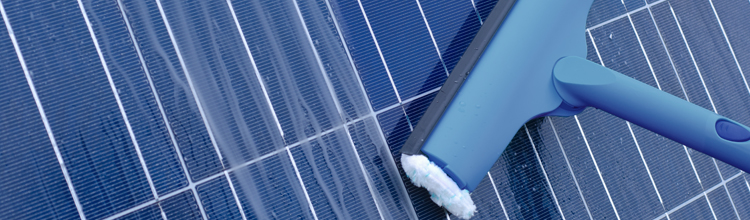
4. First try using your garden hose to get the job done (this is usually all that’s required). If a lot of dust and dirt has accumulated you can try soapy water as well as a squeegee with a long extension.
5. Don’t use metal objects or harsh abrasive products for removing caked on grit. If you scratch or cloud the glass on your solar panels, their performance can be negatively impacted.
A final consideration…
Unless you live in a highly pollutant/dusty area, or have panels mounted on a low-pitch or flat roof, the need to wash your solar panels is quite low. Most modern panels feature a hydrophobic coating that is resistant to debris. Unless you can see visible grit on the panels, water from rain will do most of the work to keep your panels clean.
For more information about booking a solar panel health check or to schedule yours, go to our maintenance page.
How Many Solar Panels do I need for my Home?
It’s a question we hear from potential customers all the time: how many solar panels do I need to install?
Whilst this may seem like the obvious question to ask, it’s actually one of the last answers you’ll get when figuring out the type of solar power system you should install.
What you’ll need to know first is how much energy your home is currently using.
To get the answer to this million-dollar question, you’ll need a copy of your last electricity bill. Look out for your daily average usage as this will be key to uncovering the number of solar panels you should install. Your bill will denote your electricity consumption in kWh (or ‘units’ on some bills). If there is no daily average figure, simply divide the monthly or annual average by 30 or 365 respectively to reveal the daily average figure.
What are your savings expectations?
Do you want to offset your electricity costs, neutralise them or aim to earn a credit from your power company every quarter?
Your savings expectations directly impact the number of panels you should install on your home, as well as other factors such as location and installation conditions. Since solar panels thrive on sunlight, locations with more ‘daylight hours’ (for example, Perth) will require less panels to achieve the same result than areas that receive less daylight hours, such as Hobart.
Other influential factors impacting on energy production include solar panel shading, orientation (the way they’re facing), changing seasons and weather conditions. Your solar power retailer may add a small buffer on top of your average daily production to offset these factors.
Finding the right system to meet your need
To work out what size system you should install (e.g. 3 kW, 5 kW, 7 kW etc.), you’ll need to crunch some numbers.
Each kW of solar you install will produce around 4 - 4.5 kWh per day (depending on the aforementioned factors). To ascertain the size of the system you need, just divide your daily consumption by this amount.
E.g.: 14.3 kWh (daily average) / 4.5 kWh = 3.1 (3 kW system)
Your solar retailer can help you calculate these figures as well as tell you the average daily kWh production of your proposed system.
Choosing the right solar panels
There are plenty of solar panels on the market to choose from, but only a handful of them will provide a long, efficient (and painless) experience. If you’re trying to decide between premium and cheap solar panels – don’t miss this blog covering the topic.
We recommend installing solar panels that fall into the top two tiers of quality from manufacturers that have Australian support for customers.
How many solar panels do you need for your home?
Once you’ve decided which solar panel model you’re going to install, you can divide the total kW required by the output of each panel.
This will reveal how many panels you need to install on your home.
Remember that not all panels are the same size – in terms of physical size as well as output. In the case of solar panels in the output range of 250 W - 265 W (which are quite common), you would need 12 panels for a 3 kW system.
E.g.: 3 kW / 250 W x 1000 = 12
Don’t forget
Solar panels will produce electricity whilst the sun is up and what you don’t use, you sell back to your retailer. Your retailer will only give you between 5c and 10c for each kWh (or unit) you send back to them. Factor this into your calculations, because if the majority of your consumption is at night, you’re not going to get the financial benefits you desire, despite producing enough energy to cover your usage.
To increase your savings, you need to use the power you produce and reduce the amount you export.
Clever design can help with this. For example, installing panels on the western aspect to increase afternoon production, suiting families that run an air conditioner or cooking appliances later in the day. Other tricks include load shifting – which is a fancy way of saying ‘using more electricity during the day’ (as opposed to night). This could include pool cleaners, washing machines or dishwashers whilst output from solar PV is at its highest.
For more information about solar panels, our team of experts are here to help!

Liberal Vs Labor: Who’s Looking Out For The Environment At The Federal Election?
You’ve probably heard by now that the 2016 Federal Election is set to take place on Saturday June 2. And if you hadn’t heard, no doubt you will be bombarded with campaign messages from the major parties soon enough.
As always, both the Labor and Liberal parties will do their best to convince the country why their plan for Australia is best – and of course, why their opponents’ is not. Who you decide to vote for (assuming you’re choosing between the two big parties) will come down to a mix of personal preference and prejudice.
But since you’re reading this blog, we’re going to bet that the environment, climate change and investment in renewable energy rank highly on your priority list.
So here’s a quick summary of what the Australian Labor Party and Liberal Party of Australia have to say about these important topics.
Labor
Perhaps the biggest environmental headline from the ALP is this: 50% Renewable Energy by 2030.
Labor details its plan for an overhaul of Australia’s renewable energy scene. As part of their pitch, they uncover how Australia’s potential for renewable energy generation is 500 times greater than current power generation capacity – not to mention the huge progress countries like China, America and many European nations have made in recent times.
Labor claims that ‘the Liberal Government has done everything in its power to try and destroy Australia’s share in one of the world’s fastest growing industries with devastating consequences for our country.’
So what does Labor propose to do?
- Millions more solar panel installations on homes and businesses over the next 15 years
- Improvements in battery technology and uptake (for lower power bills)
- Greater investment in renewable energy to increase jobs and reduce pollution
- Continued support and encouragement of state governments in their renewable energy targets
Other ‘positive policies’ the Labor party has formed around the topic of environment include:
- Net Zero Pollution by 2050
- Carbon Capture On The Land
- Cleaner Power Generation
- Increased Energy Efficiency
The driver behind these policies is Labor’s position on global warming being a real threat to Australia (and the world), and the urgent requirement that steps are made to reverse it.
From the ALP website:
“If we do not act, Australia will continue to experience an increase in extreme weather events, more severe droughts and rising sea levels. All of which will come at an incredibly high cost to our economy, our environment and our way of life.”
Liberal
Comparatively, the Liberal position on climate change and the policies it will engage to combat it seem far more brief than Labor’s.
As part of their progress to date the Liberal party acknowledges Australia’s signing of the Paris Climate Change Agreement and mentions that ‘under the Renewable Energy Target, more than 23% of Australia’s electricity will come from renewable energy by 2020.’ Of course, there is no mention that the Abbott Government worked hard to reduce this target (not to mention completely abolish it!).
Moving forward, the Liberal party claim to have set an ambitious target to reduce pollution by up to 28% by 2030, based on 2005 levels. According to the Liberal party, that’s the equivalent of ‘reducing emissions per capita by up to 52% – the second largest reduction of any G20 economy.’
The Liberal party has also pledged to invest $2.5b to encourage businesses to reduce their emissions through their Emissions Reduction Fund.
The Crunch
Whilst the points mentioned here are only the tip of the iceberg that is the 2016 Australian Federal Election, from an environmental perspective at least, it appears that Labor has the edge. They seem to have a far more drastic plan for upping renewable energy consumption and investment in Australia.
Check out the Labor and Liberal party websites to read more about their respective environmental plans and policies.
Electricity Charges Are Set to Increase By 3% In WA
As of July 1, 2016 electricity charges are set to Increase by 3% In WA becoming more expensive for Western Australian homeowners and businesses.
The WA State Government announced a 3% increase to the Home Plan (A1) electricity tariff as part of their 2016-17 state budget. The increase applies to most residents and businesses supplied by Synergy, as well as those outside the South West who are customers of Horizon Power.
Aside from this price increase, the Budget forecasts further price hikes of 7% over the next three years, meaning power bills will become increasingly hard to manage for many average families. Now more than ever, homeowners are turning their sights to renewable energy to help manage the cost of rising power bills. Fortunately, a great range of technology is available. As a solar power retailer, Solargain has already helped over 40,000 homeowners across the country slash their electricity bills, here’s five ways to reduce your energy bill:
1. Install Solar Power
A 5kW solar power system can save an average household (with around four occupants) as much as $1990 every year. Though this number varies depending on the installation type and location, it goes to show the real benefits that switching to solar has on the hip pocket.
Today, solar panels are dramatically cheaper compared to what they were just eight years ago. For example, an average 5kW solar power system in 2008 cost up to $40,000, whilst today that figure has plummeted to just $6500.
Best of all, solar panels and inverters are now smarter than ever, making them more efficient and reducing the time it takes for your investment to be returned.
2. Install Solar Hot Water
Water heating accounts for a huge portion of the overall energy usage in your home. Installing a solar hot water system is an easy way to cut these costs down.
In fact, solar hot water neutralises up to 80% of your water heating costs. And even better you never have to worry about running out of hot water – because all solar hot water systems come with a gas or electric booster.
When coupled with solar panels, installing solar hot water gives you the satisfaction of minimising electricity costs across all areas of your home.
3. Consider Battery Storage
Solar batteries allow you to store excess electricity generated by your solar panels during the day for use at night. It’s predicted that these revolutionary products will one day feature in every home that has panels, and early adopters are already seeing the benefits.
Using your own stored energy in the evening means even less reliance on the grid for power… and that equals lower electricity bills.
4. Choose Smart Lighting & Appliances
Switching to renewable energy is one half of the journey to lower electricity bills – the other is slashing your consumption. This can be achieved by using energy-efficient lighting (such as LEDs and timers) along with appliances and white-goods that score highly in the Government’s energy rating system.
Making a conscious effort to conserve power also goes a long way. There are plenty of tips out there to help you do this… and to spur you along why not turn your pledge to save power into a family challenge?
5. Shift Your Usage
For those of you who’ve already installed solar power, try load shifting to ramp up your energy savings. Load shifting refers to re-adjusting your energy usage so that you consume more electricity during the day.
Solar panels and inverters don’t work at night which means that all the electricity you use when the sun goes down is actually being derived from the grid (unless you’ve got solar batteries).
Load shifting helps you to take advantage of the energy being produced by your panels during the day. Some examples of load shifting include running washing machines, dishwashers, heating, cooling and pool cleaners during the day as opposed to night.
You’ve Got The Power
Though it can seem like we’re at the mercy of the Government when it comes to the cost of electricity, you’ve got the power to pay less for your utility bills. By using solar energy and making changes to the way you consume power at home, you can make a huge difference to your overheads.
For more information about solar power or solar hot water – or for an obligation-free quote, get in touch with our team today!
Comparing Solar Hot Water Systems
Solar hot water systems are pretty great.
Not only can they slash your electricity costs by a significant margin, but they add value to your property and contribute to a greener planet – and that’s a good feeling.
But comparing solar hot water systems, and choosing from the countless brands and products available can be tricky.
Before Solargain became one of the largest suppliers of solar panels in Australia, we were exclusively a hot water company. Our roots stretch back to 1995 as a one-man plumbing business which, over the years, has grown rapidly thanks to quality products and workmanship.
Today we’re one of the biggest solar hot water companies in the country, and we proudly stock our own range of Solargain-branded systems (as well as products from other leading brands). If you’re comparing solar hot water systems, you should definitely include us on your shopping list. Here’s why:
Designed By Plumbers For Australian Conditions:
Unlike many competitors, our range of Solargain-branded hot water systems have been designed by plumbers specifically for Australian conditions. We offer a full range of solar hot water products, including roof and ground-mount systems with both electric and gas boosting. Other brands we carry such as Dux, Quantum and Rheem also have a significant Australian presence which is important when it comes to after-sales care (more on that below).
Specs/Warranty
The Solargain range of hot water systems are competitively matched with systems from other brands. Like any investment if you’re shopping for solar hot water systems it’s important to compare apples with apples. Make sure you’re comparing specifications between solar hot water systems of the same style, size and output.
Another consideration is where the supplier is based. For example, since Solargain is a 100% Australian owned and operated company you can be assured that after-sales support will be available if you need it. This is especially true for our Solargain-branded range, as well as the other brands we carry which all have Australian-based offices.
Making service and/or warranty claims with other brands that are based overseas can result in lengthy delays waiting for parts and/or labour.
Installation And Plumber Quality
We’re confident in the quality and reliability of all the solar hot water brands we stock.
Adding to this, it’s important to note that we train most of our plumbers from apprenticeship through to fully-qualified tradesperson – and we conduct regular audits on workmanship. When comparing solar hot water products also ensure they’ll be installed by a qualified plumber who adheres to regulation.
Don’t settle for anything less when choosing your solar hot water installer.
Ready to see some quality hot water gear?
Check out our full range of solar hot water products, or get in touch with our team if you have any questions.
Solargain
Choosing the Right Solar Panel for You | Cheap vs Expensive
It’s an age-old question that impacts many buying decisions – should I fork out for premium quality or settle for the cheaper option?
When it comes to solar panels although they all look similar, they are not created equally – therefore we recommend doing your research. Pay special attention not only to the price, but more importantly to the quality of the solar panels. Also, research the manufacturer and provider because a 25 year warranty is only as strong as the company backing it.
Here are 6 things to consider when choosing your solar panels.
The Three Tiers of Quality
There are three tiers of manufacturer quality and at Solargain we only recommend solar panels from the first two tiers (one and two). These are less prone to manufacturing defects such as hot spots, discolouration, snail trails/micro cracks, delamination, connector burn-outs, isolator failures, junction box failures and quick degradation. Solar is a long term investment so it’s important to choose solar panels that won’t let you down.
TIER 1
TOP 2% OF SOLAR MANUFACTURERS
- Vertically integrated (own their supply chains)
- Invests heavily in research and development
- Advanced robotic processes
- Manufacturing solar panels for longer than 5 years
TIER 2
SMALL TO MEDIUM SCALE MANUFACTURERS
- No or little investment in research and development
- Use only partial robotics, also reliant on manual work from human production lines
- Usually producing panels for 2-5 years
TIER 3
ASSEMBLERS ONLY – 90% OF NEW SOLAR PV
- No investment in research and development
- Assembly of panels only – do not manufacture silicon cells
- Uses human production lines for manual soldering of solar cells instead of advanced robotics
- Assembling panels for 1-2 years
Term of Investment
No intentions of moving - If you are in the home you're installing the panels on for the long term (five years or more) or just demand the best – you should consider premium panels. Premium panels are more efficient, they are made from superior quality materials and will degrade less than any other panels over time. Highly advanced and backed by science and research, these products are designed to perform better in extreme heat and lower light. An added bonus, premium panels often come with more comprehensive warranties too. These features don't pay for themselves straight away, but over the long term, their advantages are clear.
Three - five years - If you are planning on being in your home for more than three years, we recommend choosing tier one solar panels. This will ensure your panels will continue to produce solar power well into the future. This will save you more money in the long run. Tier one solar panels usually have a linear warranty too. This guarantees a maximum performance reduction of a fixed percentage over the 25 year warranty period.
One - three years - Planning to move out in a few years? In this case it would be worth considering a tier two solar panel option. This is a more cost effective option with a shorter payback period, allowing you to reap the benefits of solar whilst you are at the property, without breaking the bank.
The Manufacturer and Warranty
Regardless of how long you are planning to be in your home and what tier suits your requirements, at Solargain we always recommend choosing a solar panel from a manufacturer with a strong presence in Australia. This local support will ensure a smooth and easy warranty process if anything does go wrong. Look for a 25 year linear performance warranty. Manufacturers who produce inferior products may not honour their warranty, so remember that your warranty is only as good as the manufacturer behind it.
Check the level of automation (robotic processes) the manufacturing uses - the less human hands the panel is in contact with, the less prone it is to defects. You should also find out how long the manufacturer been producing panels for – the longer, the better.
The Provider (company you buy your panels from)
Make sure the provider you choose has a high standard of products and service that can be backed up. A sure fire way to check this is to see if they have any certification or accreditations e.g. CEC accreditation. Another consideration: Make sure your supplier has installed plenty of panels from the manufacturer you’re considering – e.g. QCELLS. Providers that have installed panels from manufacturers over several years will have a deeper understanding about the quality of the product though dealing with them first hand. If the manufacturer was inferior, the provider would have moved on to another manufacturer. At Solargain, we only provide solar panels that meet our strict supplier selection process. This is simply to protect our customers and ourselves from the costly situation of frequent faults and manufacturers not honouring their warranties. We plan to be here for the long run and are committed to providing superior sales, service and support Australia-wide. Therefore, we only choose high quality Clean Energy Council approved Australian-supported panels from brands such as Fronius, Enphase, SMA, ReneSola, and QCELLS.
After Sales Support
Make sure your provider has a dedicated service and support centre. This will provide peace of mind and assistance with warranty claims, faults, service and repairs. Good providers will also have plenty of downloadable information you need for the solar panels you purchased, including warranty information and specifications.
Cost Vs Value
Sometimes it’s hard to resist being lured by ‘rock bottom’ prices. But it’s always worth stepping back and evaluating cost vs value. The cost of something is simply its price in dollars. Meanwhile, the value is what it is worth to you. Value doesn’t always mean ‘the lowest price’ – it’s about getting the most from your product including superior quality and extended performance as well as avoiding costly repairs, poor performance and a manufacturer who won’t honour their warranty. At Solargain we think of solar power as an investment – and like all investments, it’s important to do your research. For more information about choosing better quality solar power products visit our guide: Questions To Ask Before You Buy..
Solargain
Why We’re Still Proudly Australian
Over the last 20 years Solargain has grown from a humble one-man-band to become one of the largest solar power providers in the country.
Australia has been incredibly good to us – not only providing a sunny climate, but over 50,000 happy customers along the way.
Considering Australia’s high number of average ‘sunshine hours’ during the day, it’s hardly a surprise. Our home-town of Perth for example is the sunniest city in the country – averaging an incredible 11 hours of sunlight during the summer months of January and December (which is great for solar panels!)
Over the years we’ve seen plenty of solar power companies come and go. And whilst some big players in the industry are now backed, or have been bought, by international companies, we’re proud to say that we’re still 100% Australian owned and operated.
Why does that matter?
For us, it’s about keeping our interests focused on Australia as much as possible – from hiring local staff, to supporting local organisations and initiatives. In fact, just recently we announced our latest sponsorship of the Fremantle Dockers. Aside from big AFL clubs, we’re proud to partner with plenty of other great teams and organisations such as:
Our staff includes over 100 Aussies in most states and territories, including our team of installers. Our installers take pride in their work, they also uphold a high standard of quality and consistency across all of our installations. This is because we have a ISO9001 accredited install process.
Speaking of pride, we happily stock solar power products from Australian-supported brands only. That means the brands behind all of our products have a significant presence in Australia – they’re committed to our country and will be there for support when needed.
Moving forward, our ambition is to continue offering our Australian customers truly cutting-edge solar power products and services. We love our sunny country and hope to use renewable energy to preserve its future for generations to come.
Aussie Aussie Aussie!
Solargain
Celebrating Australia and Remembering Those Who’ve Protected It: ANZAC Day
With ANZAC fast approaching on April 25, we wanted to take a moment to reflect on the significance of the occasion.
As a company that’s proud to be Australian owned and operated, Solargain acknowledges the sacrifice thousands of men and women have made (and continue to make) to protect our country and make it great.
Today ANZAC Day has come to embody the many different meanings of war. The purpose of the day is to remember all Australians and New Zealanders ‘who served and died in all wars, conflicts, and peacekeeping operations’ – it’s no longer confined to the First World War, although that’s where it originates.
The day of ANZAC (that is, Australian and New Zealand Army Corps) observes the landing of Australian and New Zealand troops at Gallipoli on 25 April 1915. The 25th was officially named ANZAC Day in 1916.
Of particular significance (and rarity) is the fact that Australia and New Zealand share the holiday, using the same name and same date of remembrance. There are plenty of other fascinating components that make up ANZAC Day. Here are a few:
- Today many Australians got to a dawn service to remember the ANZACs –though they used to be attended solely by veterans. Now, dawn services are frequented by thousands across the country in the wee hours of the morning.
- ANZAC biscuits are a delicious treat today, but during the famous Gallipoli battle, the long-lasting biscuits made from oats, sugar, flour, coconut, butter and golden syrup were used as a vital substitute for bread.
- Rosemary often makes an appearance on ANZAC Day as it’s found growing wild on the Gallipoli peninsula.
- The Last Post was usually played during war to inform soldiers that fighting had ended for the day. Now it’s a staple of memorial services, symbolising that the duty of the dead has finished.
- The phrase "lest we forget" accompanies most ANZAC Day commemorations and is used to remind us of the importance to remember those who’ve served, fought and died for our country.
For more information about ANZAC Day check out this link or go to your official city website to find out about dawn services happening around you.
Lest We Forget.
Solargain
Batter Event Perth March 2016
Organised by Solargain for existing customers, suppliers, industry partners and general public, guests were invited to the exhibition suite at International on The Water in Ascot, WA. All in all it was a spectacular event, and we’d like to thank everyone who got involved – from our hardworking team, to all our special guests who contributed to the two very exciting sessions.
The event showcased some of the most anticipated solar power products to hit the Australian market.
These included home batteries from big names such as Enphase, Fronius and LGChem as well as the latest in solar panel technology from QCELLS. Guests were also treated to other energy-saving technologies such as Solargain hot water systems and the new wave of LED lighting solutions from Integrated Power.
Of all the renewable energy products on display, there was an undeniable buzz around the solar batteries. Our team fielded plenty of questions about this new technology, the most common ones were:
- Is my current solar power system compatible?
- How do they work?
- When will they be available?
- How much do they cost?
If you weren’t able to make the launch event, we’ve dedicated a webpage to address these questions which you can view here.
Other highlights from the event included door prizes (because who doesn’t love a door prize?). A few lucky guests received Enphase Envoy S Metered energy monitors, whilst everyone who attended got a complimentary show-bag from Solargain.
Arguably though, the best part of the event was the shared enthusiasm from customers, solar energy enthusiasts and the Solargain team over the launch of what is truly a game-changer in renewable energy.
For more information about our latest range of solar battery products, contact our team.
Solargain